













Watch this on-demand webinar to learn how the EPO-TEK® PROPEL™ platform supports epoxy adhesive reliability in harsh and demanding environments.
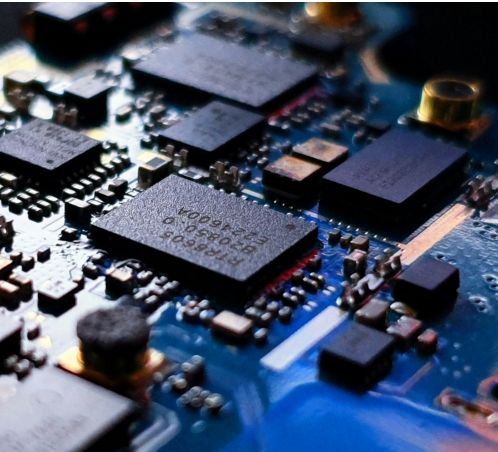
Epoxy adhesives play an important role in the reliability of many electronics products. Manufacturers use them to bond, position, seal and protect key components in consumer electronics, aerospace systems, medical devices, telecom & datacom (AI & machine learning), and optoelectronics. Low-outgassing adhesives, optical adhesives, and medical-device-grade adhesives often need to withstand heat, moisture, and other harsh conditions for long periods.
Epoxy Technology developed the PROPEL™ platform based on what it learned from EPOTEK® 353ND. It also has over 60 years of experience in formulating high-performance speciality adhesives.
The platform focuses on long-term performance in applications where adhesive reliability matters.
How Do Temperature and Humidity Affect Epoxy Adhesives?
High temperature and high humidity can create a greater reliability risk when they occur together.
A suitable epoxy can remain stable at 85°C. Adhesives with low water uptake can also limit swelling in humid conditions. However, combining heat and humidity can speed up moisture absorption and adhesive degradation.
Absorbed water can act as a plasticizer within the epoxy. It can cause the epoxy to swell and change the polymer network. In optical assemblies, these changes can move components out of position, affect alignment and weaken optical signals.
Moisture together with heat can also cause hydrolysis. During this process, water attacks chemical bonds within the polymer network and can reduce adhesion strength. Heat and moisture may also lower the glass transition temperature (Tg), which can make the cured adhesive softer.
These effects show why manufacturers should test epoxy adhesives under the conditions they will face in real-world use.
What Makes an Epoxy Adhesive Reliable?
Several properties affect epoxy adhesive reliability. Crosslink density describes how tightly the polymer network connects. A strong network can help reduce water absorption and maintain stability.
Glass transition temperature shows the temperature range where an adhesive starts to change from a rigid material to a softer one. A suitable Tg is important when the adhesive must maintain structural integrity across a wide range of operating temperatures, from room temperature to demanding high-temperature environments.
Hydrolytic stability measures how well chemical bonds resist degradation from water. This is important when products face humid environments for long periods.
Outgassing also matters in aerospace, telecommunications, consumer electronics and optical systems. Low-outgassing adhesives release fewer volatile compounds over time, reducing the risk of contamination around sensitive components.
The Cost of Adhesive Failure
Adhesive failure can cost much more than the original component. A failed bond may lead to warranty replacements, repairs, production delays and unhappy customers.
The figures shown in the accompanying video illustrate the possible scale of these costs. Warranty and replacement costs may reach 10 to 20 times the component cost. Field service and repair may reach five to 20 times the component cost, while production disruption may add another five to 10 times.
Reliable adhesive selection can therefore help manufacturers reduce failure risks and protect long-term product performance.
The PROPEL™ Platform
The PROPEL™ platform builds on EPOTEK® 353ND technology and offers specialized solutions for changing application needs.
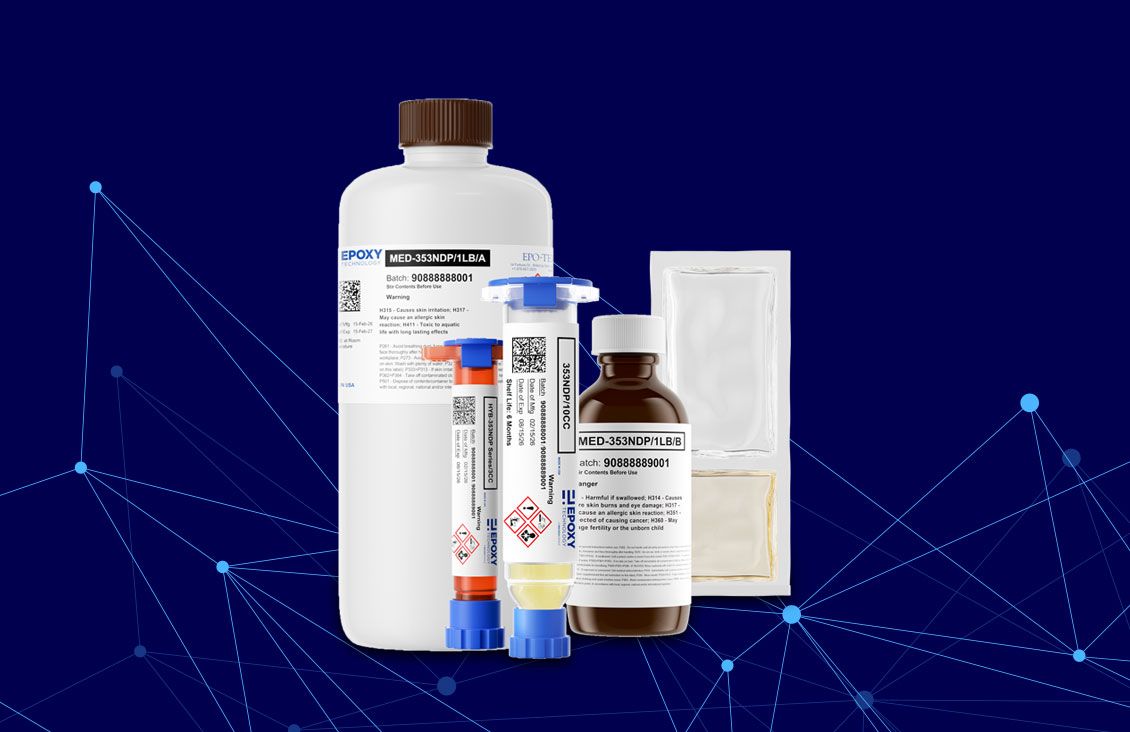
The platform includes EPOTEK® 353NDP and MED-353NDP. These adhesives support applications across consumer electronics, aerospace, medical devices, telecom & datacom (AI/ML), and optoelectronics.
EPOTEK® 353NDP for Harsh Environments
EPOTEK® 353NDP is designed to maintain adhesion during long periods of heat and humidity.
The test results presented in the video show strength retention after 2,000 hours at 85°C and 85% relative humidity. The PROPEL™ platform retained 47% of its strength, compared with 17% for the standard epoxies tested. This gives the PROPEL™ platform about three times the strength retention in this comparison.
EPOTEK® 353NDP also provides good wetting on gold, ceramic, glass and printed circuit boards. Good wetting helps reduce voids and increases contact area between the adhesive and substrates.
Applications within BOSA assemblies include fiber-to-ferrule attachment, lens and prism attachment, 45-degree filter lens bonding, Faraday glass bonding, sealing and backfilling.
The adhesive passed pressure cooker testing at 121°C, 100% relative humidity and 2 atm for 72 hours. It also passed damp heat testing at 85°C and 85% relative humidity for 2,000 hours.
The data presented for EPOTEK® 353NDP also shows compliance with NASA E595 low-outgassing requirements. The reported total mass loss (TML) is 0.76%, while collected volatile condensable material is less than 0.01%. These results support its use in low-outgassing aerospace and sensitive optical applications.
EPOTEK® MED-353NDP for Medical Devices
MED-353NDP brings PROPEL™ technology to medical device applications that need environmental reliability and biocompatibility.
The material can withstand prolonged exposure to 85°C and 85% relative humidity for 2,000 hours. It also offers two certified biocompatible curing profiles: 1.5 hours at 150°C and three hours at 120°C. The 120°C profile provides an option for temperature-sensitive materials.
MED-353NDP provides good wetting on stainless steel, ceramic, plastic and titanium. Applications include fiber bundle impregnation, wearable device potting and overcoating, ophthalmic implants and plastic bonding.
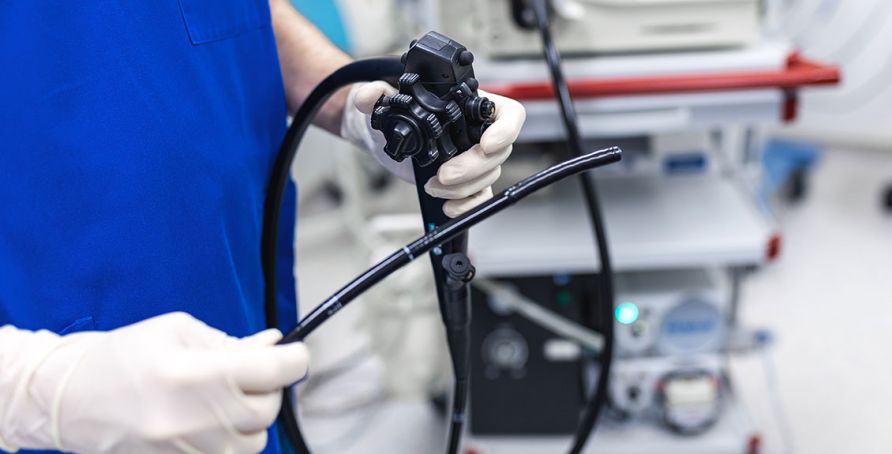
The video also covers capsule endoscopy applications, including spacers, ASIC and FPGA controller PCBs, antennas and RFID potting.
MED-353NDP passed ISO 10993-5 cytotoxicity testing using MEM elution as part of its ISO 10993 biocompatibility testing. It also passed damp heat testing at 85°C and 85% relative humidity for 2,000 hours.
Adhesive Qualification and Reliability Testing
Choosing an epoxy adhesive is the first stage of adhesive qualification. Manufacturers should also test the adhesive with the intended substrates and production processes.
Epoxy Technology and Meridian Electronics can support material selection, process integration and accelerated aging. Testing the adhesive and finished parts can help manufacturers understand how materials may perform under demanding conditions.
Meridian Electronics Application Development Center’s testing capabilities include differential scanning calorimetry (DSC), thermogravimetric testing (TGA), rheometry, die shear testing and lap shear testing.
DMA and TMA are also available. Dynamic mechanical analysis (DMA) can measure properties such as storage modulus and glass transition temperature. Thermomechanical analysis (TMA) can assess dimensional changes, including the coefficient of thermal expansion.
Die shear testing can measure adhesive strength in line with MIL-STD-883. Together, these methods can provide useful data on Tg, viscosity, storage modulus, adhesion strength, thermal behavior and material stability.
By combining material selection with relevant test results, substrate testing and reliability testing, manufacturers can assess more than initial bond strength. They can choose an adhesive based on how they expect it to perform throughout the finished product’s entire lifespan.