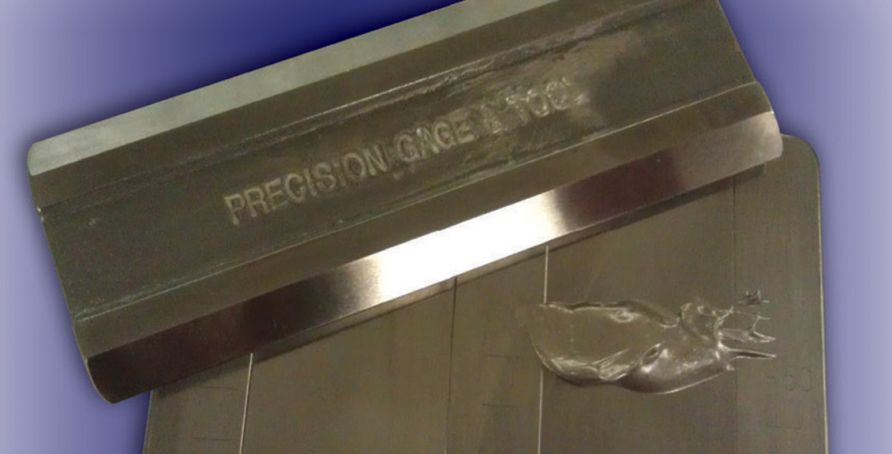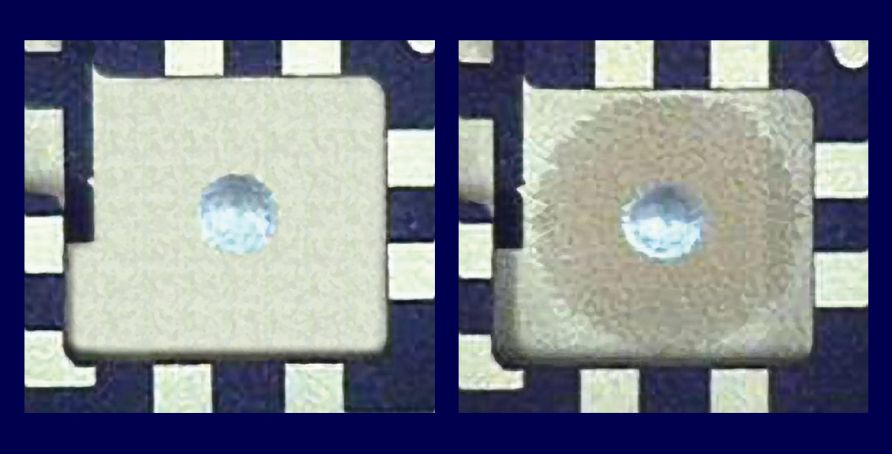



















When it comes to ensuring the quality and consistency of epoxy adhesives—especially filled systems—particle analysis is a key step in both product development and process control. One of the most efficient and accessible tools for this purpose is the Hegman Gauge (also known as a grind gauge).
In this post, we explore how Hegman Gauge analysis works, what it reveals, and how to interpret common results.
What Is a Hegman Gauge?
A Hegman Gauge is a precision stainless steel block with two shallow channels that gradually decrease in depth from one end to the other—starting at 100 microns and tapering to zero. It features a scale along both sides, which can be read in:
- Hegman units (dimensionless)
- Micrometers (μm)
- Mils
How to perform a test:
- Place a small amount of epoxy (Part A, Part B, or the mixed system) at the deep end of the gauge.
- Use a stainless steel scraper to pull the epoxy across the gauge with firm, even pressure.
- Inspect the drawn-down film for lumps, lines, or irregularities.
This simple test offers immediate visual feedback on the dispersion quality and particle characteristics within the epoxy. To ensure accurate and repeatable results, avoid these common testing errors.
- Inconsistent pressure when scrapping, which can create misleading streaks.
- Insufficient sample, which may not fully fill the gauge channel.
- Contaminated gauge – always clean thoroughly with an appropriate solvent between tests.
Why Use Hegman Gauge Testing?
This method provides a quick and effective way to:
- Evaluate filler dispersion
- Detect crystallization or agglomeration
- Measure particle size
- Ensure batch-to-batch consistency
It’s especially useful as a quality assurance tool during production or incoming materials inspection.
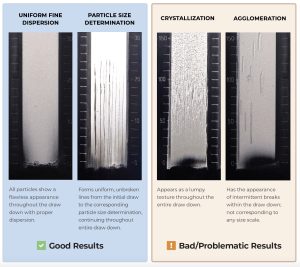
4 Types of Particle Patterns Identified
Refer to the visual examples [Reference original tech tip] of actual Hegman draw-down results for each of these categories:
Uniform Fine Dispersion (Ideal)
- Smooth, flawless appearance
- No clumps or breaks in the coating
- Indicates proper mixing and dispersion
Particle Size Determination (Acceptable)
- Draw-down shows uniform lines
- Allows clear identification of particle size using the scale
- No agglomeration or crystallization present
Crystallization (Problematic)
- Appears as a grainy or lumpy texture across the entire draw
- Suggests crystallization within the resin or filler system
- May impact adhesive performance or processing
Agglomeration (Problematic)
- Intermittent breaks, not aligned with size scale
- Indicates clumping or poor dispersion of fillers
- Can result in inconsistent flow or conductivity
Conclusion
The Hegman Gauge is a powerful, easy-to-use diagnostic tool for anyone working with epoxy systems. By identifying common particle issues like agglomeration or crystallization early, you can take corrective action and maintain high product quality and reliability.
– Use it to quickly differentiate between good and bad batches
– Ideal for routine QA and troubleshooting
– Helps ensure uniform performance in high-precision applications

Need Help Interpreting Hegman Results?
Whether you’re developing new epoxy formulations or qualifying materials on the production floor, our technical team is here to help.
Contact us at techserv@epotek.com