


















In photonic and optoelectronic design, light is both the signal and the challenge. Whether guiding photons with precision, blocking stray light to prevent interference, or eliminating surface reflections that degrade performance, the adhesive you choose is not just a structural element – it is an optical element that directly impacts system performance.
This guide provides a comprehensive overview of the three critical optical parameters—refractive index, spectral transmission, and surface reflection control—and presents a framework for selecting the right material across the full spectrum of applications, from high-transparency bonding to ultra-matte light-absorbing encapsulation.
The Science: Three Critical Optical Parameter
Refractive Index (RI)
The refractive index determines how light bends when entering the adhesive, which is critical for maintaining signal integrity at interface. Most optical epoxies have a cured RI between 1.50 and 1.57, though specialized materials extend beyond this range.
Key consideration:
- RI typically increase by ~0.03 after curing.
- RI decreases with increasing wavelength (critical for 1330nm/1550nm telecom applications)
- RI decreases with temperature – important for devices exposed to thermal variation
How it was measured:
Refractive index is measured using a refractometer at the Sodium D-line wavelength of 589.3 nm. This provides consistent reference values for product data sheets.
Spectral transmission
Spectral transmission measures how much light passes through the adhesive at specific wavelengths.
This matters for two reasons:
- Signal transmission: Light may need to pass directly through the adhesive layer.
- Selection of UV adhesive: Substrate transmission determines whether UV light can penetrate during curing
Most epoxies have limited transmission below 400nm, as UV wavelengths are absorbed to initiate crosslinking. Some materials are IR-transparent but visible-opaque, making spectral data essential for proper selection.
How it was measured:
Spectral transmission is measured using a UV-VIS spectrophotometer.
The process typically involves:
- Applying the epoxy as a coating on a glass slide
- Curing the material according to the recommended schedule
- Measuring light transmission across a wavelength range of 300 nm to 2500 nm
The result is a transmission curve showing how much light passes through the material at each wavelength.
Surface reflection control: Transmission determines
In many adhesive applications involving light signaling, reflected light is as problematic as stray transmitted light. Glossy surfaces can create unwanted reflections that interface with sensors or reduce contrast. For these applications, matte finishes are essential to diffuse light and minimize reflection. Key parameters include optical reflectance and gloss level.
How it was measured:
Optical reflectance is quantified using a gloss meter or spectrophotometer at standardized angles (20°, 60°, 85°). These measurements provide objective data on surface matte-ness and reflection suppression.
Key Parameters:
- Optical Reflectance: Measured at standardized angles to quantify surface reflection.
- Gloss Level: A measure of surface sheen; lower gloss indicates a more diffuse, less reflective surface.
- Optical Density: For black materials, the ability to absorb light across a wide wavelength range.
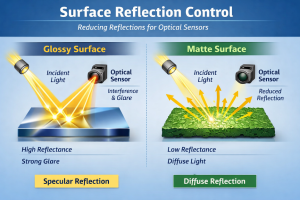
How MAG-E solves Reflection Challenges:
- Ultra-low surface gloss: The matte finish diffuses incident light rather than reflecting it, eliminating specular reflections.
- Complete light absorption: <1% transmission from 200-2500nm ensures no transmitted light reaches underlying sensitive components.
- Minimal reflectance: Advanced filler technology achieves reflectance values as low as 0.2% at 20°, providing near-total light suppression.
Ideal application:
- Image sensor modules: Eliminates flare and improves dynamic range
- LiDAR receivers: Provides absolute isolation from ambient light
- Military/aerospace optics: Minimizes detection and optical noise
- Medical imaging devices: Enhances contrast and image quality
- Any assembly where glossy surface creates unwanted reflections.
The Spectrum of Solutions
Different optical challenges require different material solutions:
| Application Need | Recommended solution |
| Maximum light transmission | High-purity optical epoxy with matched RI |
| Stray light suppression | Light-blocking or absorbing adhesives |
| Reflection elimination | Ultra matte black epoxy |
| Precise RI for waveguides | Low or high RI specialty adhesives |
| UV-cure process compatibility | UV or dual-cure acrylics/epoxies |
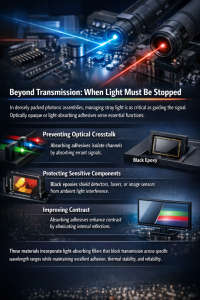
Example of scenario: when light must be stopped
- Preventing optical crosstalk in dense arrays
- Protecting sensitive components from ambient light
- Improving contrast in imaging systems
These materials incorporate light-absorbing fillers that block transmission across specific wavelengths while maintaining adhesion and reliability
Final Thoughts
As optical and photonic technologies evolve toward greater integration and miniaturization, the adhesive’s role as an optical element becomes increasingly critical. Whether your application demands precise light guidance, minimal transmission loss, complete light blocking, or absolute reflection control, understanding the interplay of refractive index, spectral transmission, and surface characteristics is essential for success.
By mastering these parameters and leveraging the full spectrum of available material platforms—from high-purity epoxies to advanced acrylics, light-blocking formulations, and ultra-matte black technologies—engineers can design assemblies that not only hold together but perform optimally as complete optical systems.

Need help selecting an optical epoxy for your application?
Contact our technical team at techserv@epotek.com