
















Epoxies are naturally thermal insulators, with typical thermal conductivity values around 0.1–0.2 W/m·K. That’s fine for many general-purpose applications. However, in many applications— power electronics, LED lighting, automotive modules, and high density assemblies —efficient heat dissipation is critical.
To meet these demands, thermally conductive epoxies are engineered with specialized filler systems that create heat flow paths — significantly improve heat transfer.
In this post, we’ll break down how thermal conductivity works in epoxy systems—and how to choose the right material for your application.
Why Thermal Conductivity Matters
Heat is the enemy of electronics. Every 10°C rise above rated temperature can halve the lifetime of a semiconductor junction. Effective thermal management:
- Maintain stable operating temperatures
- Prevents thermal runaway
- Increase device reliability and lifespan
- Allows higher power density in smaller packages
Thermally conductive epoxies are used in:
- Die attach (power transistors, IGBTs, MOSFETs)
- LED chip bonding and module assembly
- Heat sink attachment (thermal interface materials)
- Potting of transformers and power supplies
- Thermal gap filling between PCBs and housings
How Thermal Conductivity Works in Filled Epoxies
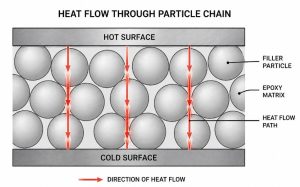
To make it conductive, thermal conductive filler particles are dispersed throughout the resin.
Key principle:
Heat flows through the filler particles, not through the resin. For efficient heat transfer, filler particles must touch each other to form continuous pathways. The concept called percolation.
This mechanism is similar to electrical conductivity in silver-filled adhesives.
The Role of Cure Conditions
Cure temperature and speed directly affect the final thermal conductivity. WHY? During cure, the epoxy shrinks (volumetric shrinkage, typically 1-5%). This shrinkage physically pushes filler particles closer together, improving contact.
| Cure Profile | Shrinkage Behavior | Particle Contact | Thermal Conductivity |
| Fast, hot (e.g., 150°C, 5 min) | High shrinkage, rapid | Maximized | Highest possible |
| Slow, low‑temp (e.g., 80°C, 2 hr) | Lower shrinkage, gradual | Reduced | Lower than spec |
| Over‑cure (exotherm) | Expansion, voids | Lost contact | Degraded |
Practical takeaway: If your process forces a low-temperature cure, you may need an epoxy formulation specifically optimized for that condition. The goal is optimized curing conditions that maximize particle overlap without introducing defects.
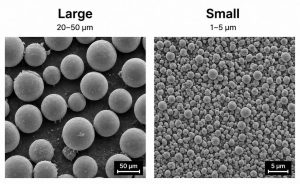
The Impact of Filler Type and Size
| Filler Characteristic | Effect on Conductivity | Effect on Processability |
| Larger particles | Higher (fewer gaps) | Harder to dispense, higher viscosity |
| Smaller particles | Lower (more gaps) | Easier dispensing, smoother flow |
This creates a trade-off between performance and processability.
Levels of Thermal Performance
Thermally conductive epoxies generally fall into three categories:
| Level | Typical Conductivity | Filler Type | Best For | Trade‑Offs |
| High Thermal Conductivity + Electrically Conductive | >10 W/m·K | Silver | Where electrical conduction is okay (e.g., solder replacement) | High cost, silver content |
| High Thermal Conductivity + Electrically Insulating | 1–5 W/m·K | Ceramics (alumina, boron nitride) | Electrically sensitive devices (LEDs, power modules) | Higher viscosity |
| Standard Conductivity | 0.5–1 W/m·K | Mixed mineral fillers | General die attach, potting, moderate heat | Lower heat transfer |
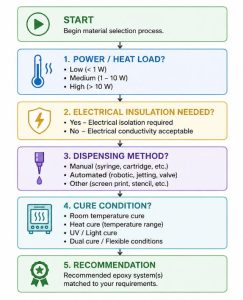
Matching the Epoxy to Your Application
Choosing the right thermally conductive epoxy depends on several factors:
- What is the requirement for thermal conductivity?
- Does it need to insulate electrically?
- How will you apply it? (dispensing, printing, potting) See Tech Tip 10 for more details.
- What cure do you have?
In many cases, the “highest conductivity” option isn’t the best choice if it compromises manufacturability.
Final Thoughts
Thermally conductive epoxies are not one-size-fits-all solutions.
Their performance depends on a combination of:
| Factor | What Drives It |
| Thermal conductivity | Filler contact, particle size, cure shrinkage |
| Processability | Viscosity, filler size, application method |
| Electrical behavior | Conductive (silver) vs. insulating (ceramic) |
The key takeaway:
Match the epoxy to your process and reliability needs, not just the data sheet number.
By understanding these factors, engineers can select the right epoxy to balance performance, reliability, and manufacturability.

Need help selecting a thermally conductive epoxy for your application?
Contact our technical team at techserv@epotek.com for expert guidance.