
















Epoxy adhesives are known for their exceptional strength – but sometimes, strong adhesion isn’t the goal. This guide explains when and why to use release agents, which materials to choose, and how to avoid common pitfalls.
What Are Mold Release Agents?
Mold release agents are applied to surfaces to prevent epoxy from bonding where adhesion is not desired. They form a thin, molecular-scale layer coating on the mold surface, which act as a physical non-stick barrier, avoiding epoxy bonding.
They allow epoxy to:
- Form into desired shapes
- Be removed cleanly from molds
- Avoid sticking to fixtures or tooling
Potting vs. Casting: Know the difference
| Process | Description | Use release agent |
| Potting | Encapsulating electronics in a permanent housing | ❌No – adhesion to housing if desired |
| Casting | Molding epoxy into a shape, then removing it | ✅Yes – for clean release |
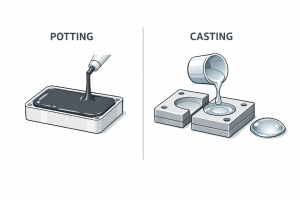
Potting vs. Casting Side-by-Side, AI-generated image.
Where Are Mold Release Agents Used?
Mold release agents are commonly used in applications such as:
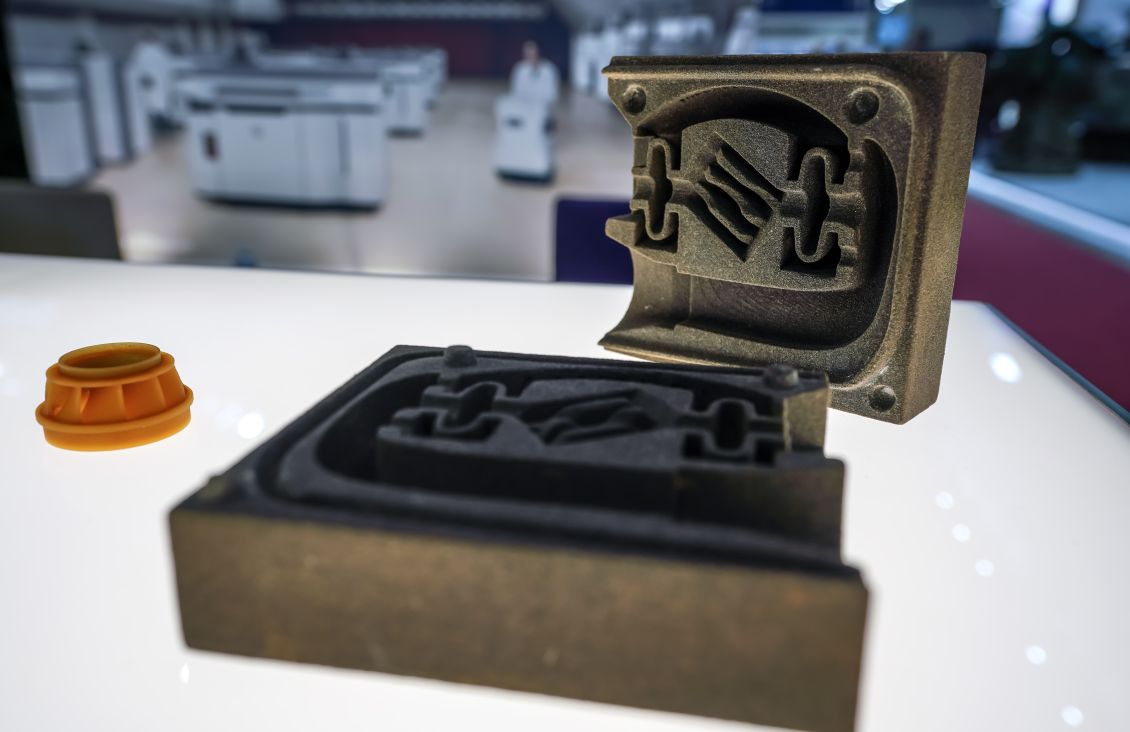
- Coating molds for epoxy casting (lenses, test samples)
- Protecting fixtures and tooling from epoxy buildup
- Preventing adhesion to unintended surfaces
Application Insight: In high-mix line
Spraying release agents on fixtures at shift start can reduce cleaning downtime significantly.
Common Mold Release Materials
| Release agent | Best for | Key consideration |
| PTFE (Teflon ®) | Multiple releases, high volume molding | Can crack under high pressure |
| Wax | Semiconductor handling, general use | Melting point must exceed epoxy cure temperature |
| Silicone | High temperature molding | Risk of cure inhibition & contamination (See Tech Tip 21 for more details) |
| Soap based | Medical or biocompatible applications | Limited resin compatibility |
Silicone warning:
I. Physical barrier
Silicone residues create an extremely low-surface-energy layer. Epoxy cannot wet this surface, leading to complete adhesion failure – the epoxy cures but bonds only to the contaminant, not the substrates
II. Physical barrier
Certain epoxy systems – especially cationic-curing epoxies (e.g., some UV-cure formulations) are highly sensitive to alkaline contaminants. Silicone residues (often alkaline) can neutralize the acid catalyst, resulting in a tacky, uncured interface.
Quick Selection Matrix
| Priority | Recommended Agent |
| High temperature (>150°C) | PTFE or wax (if temperature allow), silicone only if no downstream bonding |
| Silicone sensitive environment | Wax or PTFE (preferred), soap based for medical |
| Medical or biocompatible | Soap-based |
| Multiple releases without reapply | PTFE (semi-permanent) |
| Quick, low cost, single use | Wax |
Alternative: Use self-releasing mold materials like silicone rubber, PTFE, or polyolefin – no release agent needed.
If you must use silicone: Cleaning protocol
- Post-demolding cleaning – Remove all silicone residues before any bonding or coating step.
- Two-step solvent wipe – Use a non polar solvent followed by isopropyl alcohol
- Plasma treatment – Effective for removing trace organic contaminants.
- Verify cleanliness – Perform a water break test: a continuous water film indicates a clean, high energy surface, beading indicates
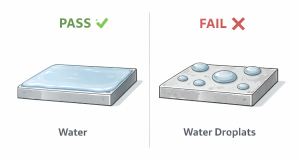
Water Break Test Comparison, AI generated image.
Daily Use Best Practices
Application:
- Spray for complex molds (thin, uniform coating)
- Brush for flat surfaces (avoid streaks)
- Allow full drying before epoxy contact
Reapplication schedule:
- Wax: 1-3 cycles
- PTFE: 10-50 cycles
- Semi-permanent: 50-200 cycles
Cleaning molds: Use appropriate solvent (acetone for wax, specialized for silicones) to prevent buildup.
Troubleshooting
| Problem | Likely cause | Fix |
| Epoxy sticks to mold | Insufficient or uneven release | Reapply, ensure full drying |
| Surface defects (craters) | Silicone contamination, trapped air | Switch to silicone-free agent, degas epoxy |
| Cure inhibition (tacky interface) | Silicone contamination (especially with cationic epoxies) | Use wax or PTFE, isolate silicone operations |
| Release agent buildup | Over application | Clean mold; switch to semi-permanent |
Manufacturing scenarios:
- Optical lens molding: PTFE or soap-based agents for defect-free surfaces
- Medical device assembly: Soap-based agents for defect free surfaces
- Fixture protection: Routine wax or PTFE spray reduces cleaning downtime
Final Thoughts
Mold release agents are essential for controlled non-adhesion. Silicone-free agents (wax, PTFE, soap-based) are the safest choice for most applications, especially when downstream bonding or coating is required. If silicone must be used, a rigorous cleaning and verification protocol is mandatory. Whether you’re working in electronics, optics, or medical device manufacturing, proper use of mold release agents can significantly enhance your epoxy processing workflow.

Need help selecting the right epoxy or mold release strategy?
Contact our technical team at techserv@epotek.com or our Epoxies, Etc. technical team at sales@epoxies.com.