
















When working with epoxies, timing is everything.
Terms like pot life, working life, and gel time are often used interchangeably—but they mean different things. Mixing them up can lead to thick paste when you need flow or shifting parts when you need good positioning.
This blog explains each term, how they relate, and how to use them to select the right epoxy for your process.
Why These Terms Matter
Epoxies change after mixing. Viscosity increased, affecting dispensing, wetting, and positioning. Understanding this window helps you:
- Apply consistently
- Avoid waste
- Match material to your production pace
As a result, pot life, working life, and gel time are critical factors in epoxy selection for any application.
What Is Pot Life?
Pot life is a standardized lab measurement. It’s the time (at 23°C) for the epoxy’s viscosity to double – or quadruple if the starting viscosity is under 1000cPs.
Because it’s a defined test, pot life lets you compare products side by side. But it’s a baseline, not a promise of usability on the factory floor.
- Example: EPOTEK H70E’s viscosity doubles after about 56 hours at room temperature.
| Time (hrs) | Time (min) | Viscosity (cPs) |
| 0 | 0 | 5,632 |
| 24 | 1440 | 6,349 |
| 48 | 2880 | 8,397 |
| 51.5 | 3090 | 9,523 |
| 54 | 3240 | 10,137 |
| 56 | 3360 | 11,059 |
From this, you can estimate:
- At ~112 hours → viscosity may exceed 22,000 cPs
- At some point before that → the epoxy becomes too thick to work with
Pot life categories
To simplify material selection, pot life is often grouped into general ranges:
| Pot life length | Approx. duration |
| Quick | <1hour |
| Short | 1 – 4 hours |
| Medium | 4 – 8 hours |
| Long | 8 – 24 hours |
| Days | >2 days |
Use these ranges to shortlist epoxies for your product speed and production environment.
What Is Working Life?
Working life is the practical window – it refers how long the epoxy stays low enough in viscosity to actually apply for your specific application. There’s no standard test because it depends on:
- Your dispensing method (needle, screen, brush)
- Environmental conditions
- How much viscosity you can tolerate
Simple rule:
Pot life is a measured number. Working life is your usable window – usually shorter than pot life, especially for automated dispensing.
What Is Gel Time?
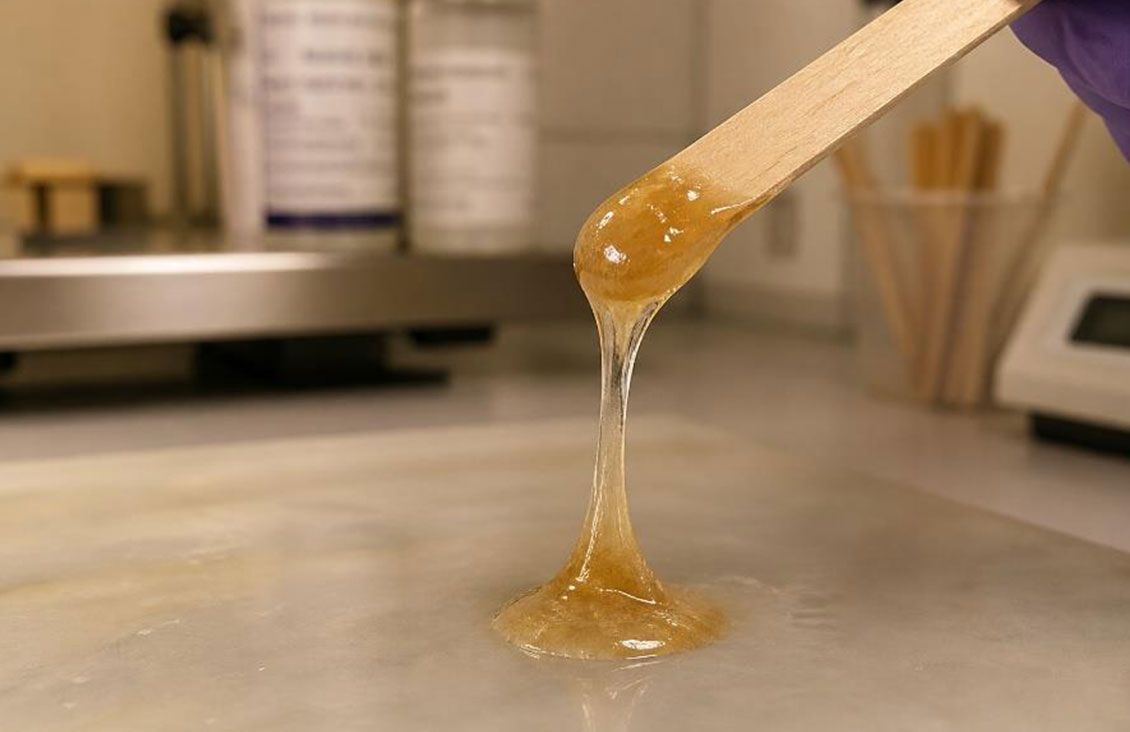
Gel time is when the epoxy starts to transition from a liquid to a semi-solid, stringy state. This usually happens later than pot life, and it’s often measured at elevated temperatures (e.g., 100°C or 120°C) to stimulate curing conditions.
Why does gel time matter? It tells you when parts can be handles without shifting, or when you’ve lost the stability to reposition components. For many processes, this is the real “deadline” for positioning.
Note: Gel time is not a standardized QC test – determine it experimentally for your application.
Practical tips for the production floor
- Cold plate extends working life. If your room runs warm, mix small batches or use a chilled work surface.
- Premixed frozen (PMF) syringes have a working life shorter than the listed pot life – material starts reacting as soon as it thaws.
- Don’t trust your eyes only. A viscosity that feels “still okay” may already be too thick for fine dispensing. Test first.
One more distinction: Gel time vs. Set time
- Gel time = stringy, semi-solid stage (can still be deformed)
- Set time = hard enough to handle without damage (no longer deformable).
Set time is often what assembly operators really care about – but it’s rarely on the data sheet. Ask your supplier for application-specific guidance.
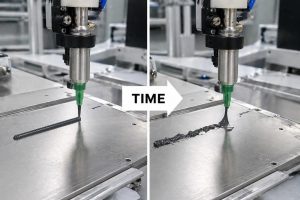
The viscosity of the adhesive above increases over time, which caused an issue with the dispensing.
Final Thoughts
| Term | What it tells you | Standardized? |
| Pot life | Lab baseline – viscosity doubles | Yes |
| Working life | Useable window for your process | No |
| Gel time | When epoxy turns stringy (often at elevated temp) | No |
Match the epoxy’s pot life to your production line speed, test working life under real conditions, and know the gel time if you need to handle parts before full cure.
The key takeaway:
Don’t rely on just one number—understand the full lifecycle of your epoxy.

Need help selecting an epoxy with the right processing window?
Contact our technical team at techserv@epotek.com or our Epoxies, etc. technical team at sales@epoxies.com.